TransMilenio, in short — the system you'll actually ride
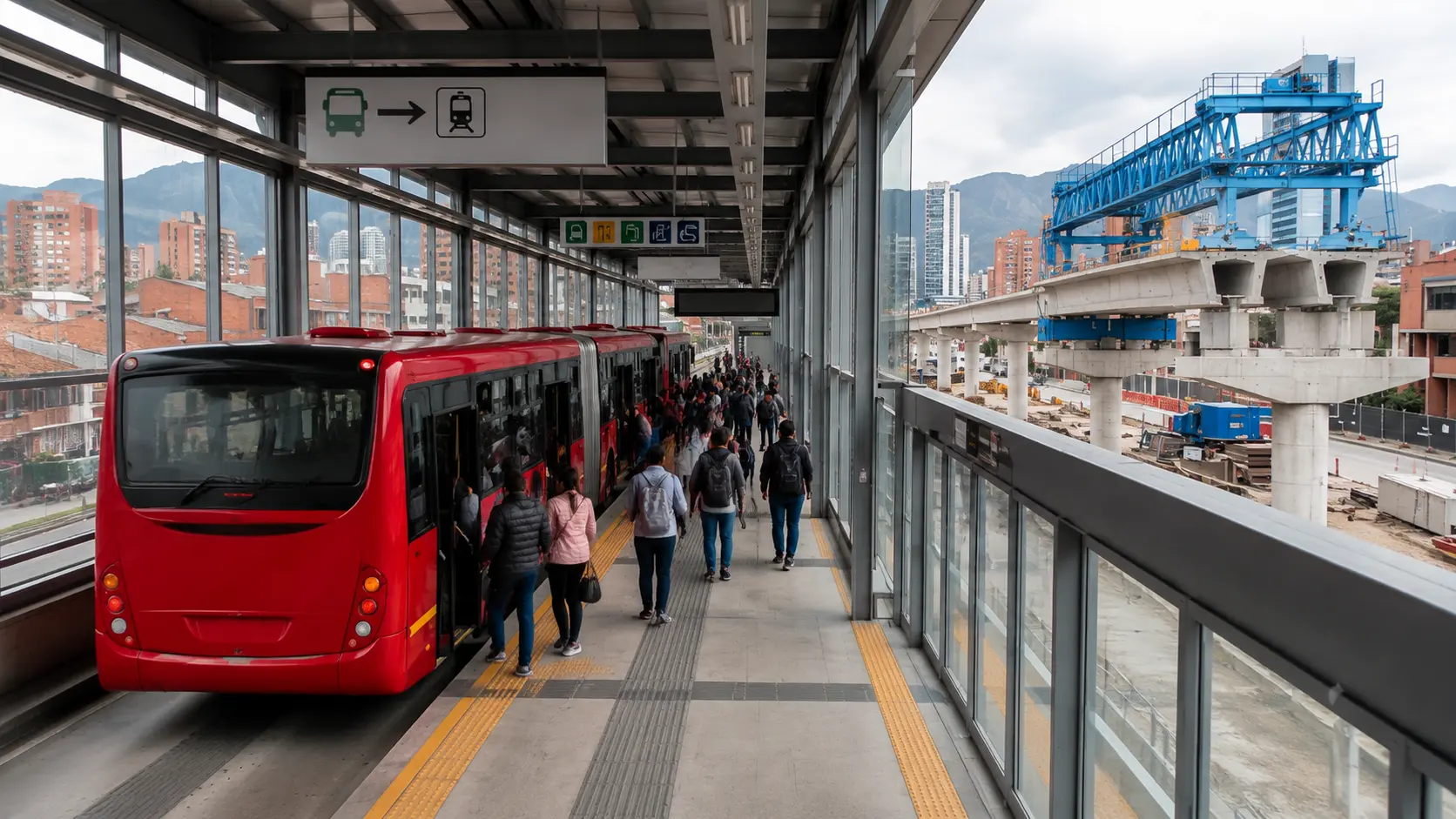
If you're visiting Bogotá before the metro opens, TransMilenio is how you'll get around the city. It's Bogotá's bus rapid transit (BRT) system: high-capacity articulated buses running on dedicated, car-free lanes ("troncales"), with enclosed stations and pre-boarding payment — functionally closer to a metro than a regular city bus. It opened on December 4, 2000, under Mayor Enrique Peñalosa, after construction began in 1998-1999, according to Wikipedia and Pulzo. It was modeled on the BRT system in Curitiba, Brazil, and was Latin America's third BRT, after Curitiba itself and Quito's trolebús, according to Wikipedia and La Silla Vacía. Today, 25 years on, it runs more than 10,000 buses across 139+ stations and forms the backbone of the SITP, Bogotá's integrated transit network, according to Colombia One.
Why TransMilenio exists: it's the metro Bogotá couldn't build
Here's the part most visitors never hear, and it's the reason this site — built around Bogotá's metro — is covering a bus system: TransMilenio wasn't conceived as an alternative to a metro. It was conceived alongside one. Bogotá's mass-transit plan from the 1990s had two parts: a "rigid" one (a metro line) and a "flexible" one (a high-capacity bus network). When the national government changed and funding for the rigid component never materialized, the city moved forward with only the flexible half — and that's how TransMilenio was born, according to its first general manager, Édgar Enrique Sandoval, in an interview with El Tiempo.
In other words, for the 25 years Bogotá went without a metro — the same wait covered in our piece on why it took Bogotá more than 80 years to build one — TransMilenio was, in practice, the metro the city could actually build. Free commercial service began on December 18, 2000, with just 14 articulated buses running on the Caracas and Calle 80 corridors, carrying about 18,600 passengers on day one, according to Colombia One and El Tiempo. Getting from those 14 buses to today's fleet of more than 10,000 took 25 years — roughly the same 25 years it took Bogotá to secure funding for an actual metro.
How it will connect to Metro Line 1
Metro Line 1 won't have its own separate fare: it will be integrated into the SITP (Bogotá's Integrated Public Transport System) — the same network TransMilenio anchors — through the Interoperable Fare Collection System, according to Empresa Metro de Bogotá itself. In practice, that means paying with the same TuLlave card already used on TransMilenio, with no separate card or payment system for the metro. If you're planning a longer stay that overlaps with the metro's projected opening, our fares guide breaks down that integration, plus the current SITP fare as a reference point.
A December 2025 source, published around the system's 25th anniversary, frames the road ahead well: after a quarter-century of single-handedly covering the city's mass transit, TransMilenio's next chapter isn't competing with Line 1 — it's integrating smoothly with it, and with the future RegioTram, according to Colombia One.
What the "TM" badge means on this site's station pages
That circle is already visible today, even before the metro opens: on this site's Line 1 station list, 8 of the 16 stations carry a "TM" badge, marking a direct connection to a TransMilenio trunk line (Américas, NQS Sur, or Caracas, depending on the station). Several of those — Avenida Jiménez, Hospital, and Chapinero among them — connect directly to the Caracas trunk, one of the two original corridors TransMilenio launched on back in December 2000. That's not a coincidence: it's the same corridor where the "metro" Bogotá managed to build 25 years ago got its start, now linking up with the one the city is finally building.