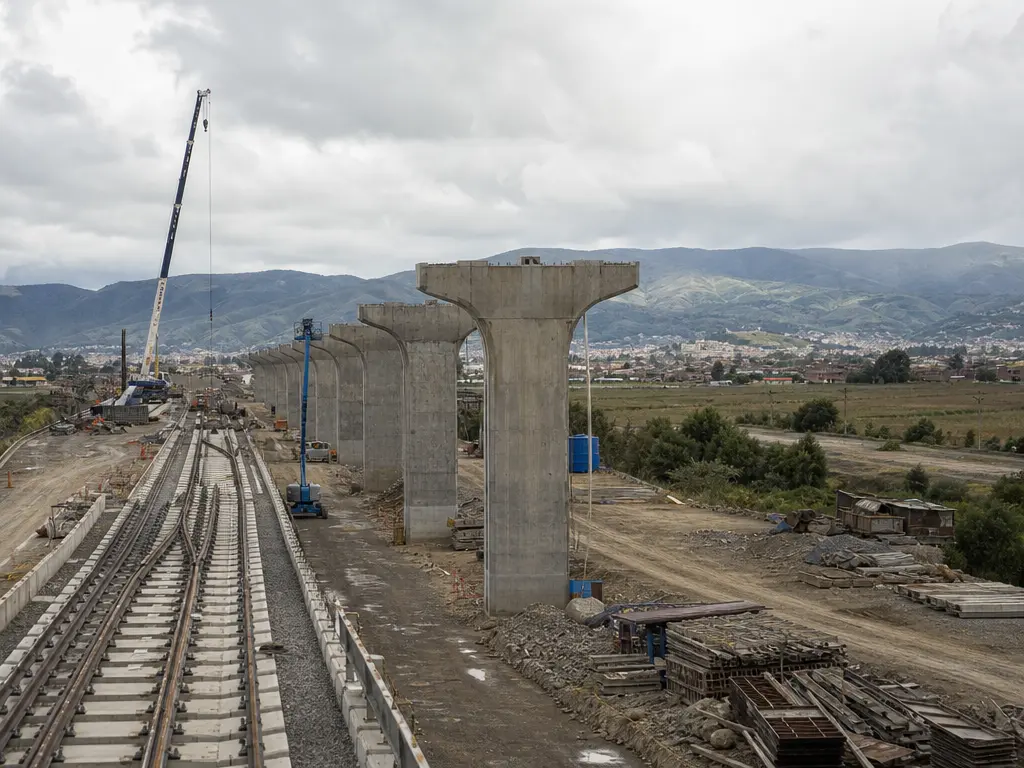
What the RegioTram de Occidente is, and where it meets the Metro
Straight answer: the RegioTram de Occidente is a 100% electric commuter rail line that will connect Bogotá with the municipalities of Facatativá, Madrid, Mosquera, and Funza, in Cundinamarca's western Sabana region — the first project of its kind in Colombia, according to Wikipedia and bogota.gov.co. It's run by a different agency altogether, the Empresa Férrea Regional (EFR) and the Cundinamarca departmental government — not Empresa Metro de Bogotá. But it connects physically with Line 1 at one very specific point: its terminal station will sit at Calle 26 and Avenida Caracas, the exact spot where Line 1's Central station is already built, allowing a direct transfer between the two systems, according to El Tiempo. You can see the details of that station, and the connections it already has today, on the Central station page.
The Empresa Férrea Regional's general manager confirmed it to El Tiempo: the RegioTram will also connect with the main intersections it crosses alongside TransMilenio — Avenida Boyacá, Carrera 68, Avenida Ciudad de Cali, Hayuelos, Avenida NQS — "and, finally, we connect with the metro." If you're curious how TransMilenio fits into that same picture, we've covered that integration separately.
From a 2019 contract award to three years of stalled construction
The project didn't start cleanly. It was awarded in December 2019 to a Chinese consortium, CCECC, but was suspended indefinitely in April 2023 over unapproved environmental permits, according to Wikipedia. Construction stayed frozen for a full year, until the government issued a decree in April 2024 exempting the project from that specific approval process — and in June 2025, construction of the first segment finally began. It's a stumble that will sound familiar if you know the story of the metro's own 80-year wait: another Bogotá mass-transit project that had to work through years of administrative paralysis before any machinery hit the ground.
When the connection will be ready: two dates that don't agree
The first segment — Facatativá to Fontibón, roughly 26 km — has a reasonably consistent target across sources: late 2027, according to El Tiempo, El Nuevo Siglo, and Wikipedia. But that segment doesn't reach Central station yet, and doesn't connect to the metro. For the full connection, sources disagree: El Tiempo puts it at 2028, El Nuevo Siglo at 2029. We're not picking one — these are two different estimates for the same milestone, and neither source carries more authority than the other today. The sensible read is to treat both as projections, not a locked-in date — the same standard we apply to Line 1's own opening date.
A train that turns into a tram once it hits the city
The technology behind the RegioTram is called "tren-tram": the same units run at train speed — up to 70 km/h — through rural stretches, then behave like an urban tram once they enter built-up areas, according to bogota.gov.co and El Tiempo. In practice, that means the RegioTram will run literally through the streets of Bogotá's Santa Fe neighborhood — the same district where Central station sits — sharing road space instead of running on an exclusive elevated structure the way Line 1 does.
Each unit is roughly 100 meters long, built from two connected car bodies, with room for about 964 passengers per trip, fully electric; the full fleet will be 18 trains. And here's a detail that ties directly into what this site is about: RegioTram trains are built in the same factory as Metro Line 1's own railcars, according to El Tiempo — two projects run by different agencies, built, literally, on the same production line.
Progress on the ground backs up those dates: as of June 2026, overall construction is past 40%, according to El Nuevo Siglo. The El Corso rail yard in Facatativá — where fleet maintenance, storage, and the operations control center will be based — is already past 45% complete. A prototype train is already on display outside the Cundinamarca governor's office; the rest of the fleet arrives in early 2027 to begin technical testing.
What it means for travel time — and who's footing the bill
Today, the trip between Facatativá and Bogotá along Calle 13 can take 2 to 3 hours because of congestion, according to El Nuevo Siglo and Infobae. Once the RegioTram is running, that same trip would drop to around 55 minutes. The full system will run 39.6 km (14 km inside Bogotá) with 17 stations — 9 in Bogotá and 8 split across the four municipalities, two each — according to bogota.gov.co, El Tiempo, and Wikipedia. It's projected to carry between 125,000 and 130,000 passengers a day, and to avoid emitting 165,000 tons of CO2 a year, according to El Tiempo and El Nuevo Siglo.
How you'll pay — and who's paying for construction
There's no confirmed fare figure yet. What is confirmed is the model: it won't be a flat fare like the SITP's — it'll be an open system where you pay with an e-wallet or credit card, calculated by the exact distance traveled. Figures that have circulated in the past — around COP $3,600 in a 2022 statement, around COP $7,000 in more recent Wikipedia sourcing — are estimates that have shifted over time, not a locked-in number. The metro's own fare, once it opens, follows a different path: it integrates into the SITP — see that detail in the metro's fares guide.
Construction is funded through a co-financing agreement signed in 2017 that's still active and current on payments: 70% from Colombia's national government, 30% from the Cundinamarca departmental government, according to El Tiempo.
Two sibling projects, much further behind
The RegioTram de Occidente is the first of a wider network the Cundinamarca government is planning for the region: RegioTram del Norte (toward Zipaquirá) is still in design, and RegioTram del Sur (toward Soacha) is only at the project stage. Neither has a construction timeline yet. Orlando Santiago, the Empresa Férrea Regional's general manager, did confirm one concrete step for the Norte project in an interview with La FM Fin de Semana: "this July we'll open the public tender" — a tender, not the start of construction, but real progress compared to the two projects that today exist only on paper.
The short version
Here's the detail that ties this whole post together: the RegioTram de Occidente and Metro Line 1 won't just share a station — they're built in the same factory. Beyond that curiosity, here's what's actually confirmed: the first segment, Facatativá-Fontibón, is expected by late 2027; the full connection to Central station is projected for 2028 according to El Tiempo, or 2029 according to El Nuevo Siglo — two conflicting estimates, neither locked in. Once that connection is ready, you'll be able to transfer directly between the two systems at Central station, the same station Line 1 is being built to reach today.